




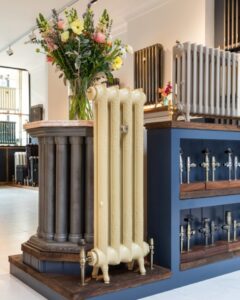
American Radiator Company
“When American Radiators are installed in any building, the owner may be assured that they have the best.” – The Ideal Fitter (1925)
The History of the American Radiator Company
Who Was the American Radiator Company?
In the last 150 years, thousands of radiator manufacturers have come and gone, but none have left as lasting an impact as The American Radiator Company (ARCo). They revolutionised radiator design and pioneered advancements in casting techniques and mass production that shaped the modern radiator industry.
To this day, ARCo remains the most influential name in radiator manufacturing, they were the inventor of the modern cast iron radiator.
Image: The American Radiator Company’s exhibition at the St Louis World’s fair titled ‘How to Heat the Home’ (1904)

The Rise of an Industrial Titan
Through the mid- to late-19th century, the radiator was finding its form. Early designs included radiators made of sheet iron, wrought iron, and eventually looped cast iron tubes in the 1870s with the popular ‘Bundy Loop’.
Despite the rapid evolution of the radiator throughout the mid-19th century, the heating industry remained fragmented, with several regional companies dominating their respective states. In 1892, three major players in Pierce Steam Heating of Buffalo, the Michigan Radiator Company, and the Detroit Radiator Factory, merged to form the American Radiator Company (ARCo), a national enterprise with the capability to supply radiators across the country in a thriving American economy.
Each company brought unique strengths to the merger. Joseph Bond from Pierce Steam Heating had recently patented a revolutionary method for connecting radiator sections using a threaded nipple with a flange, a technique that remains the standard today. This innovation laid the foundation for the modern sectional cast iron radiator, positioning ARCo as a dominant force in the industry.
Image: The American Radiator Company’s Pierce Plant of Buffalo, New York.

Forging a Path in the Gilded Age
By the time ARCo was founded, central heating was already becoming a common feature in major cities like New York. But the late 19th century, known as the Gilded Age, was an era marked by rapid industrial growth, wealth, and a love for lavish design. During this period, even radiators were not just about heating; they were about making a statement.
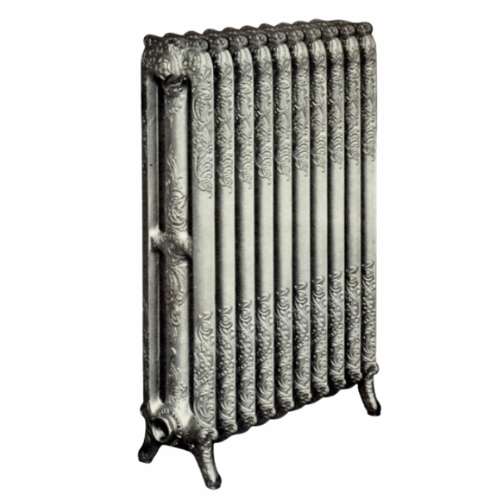
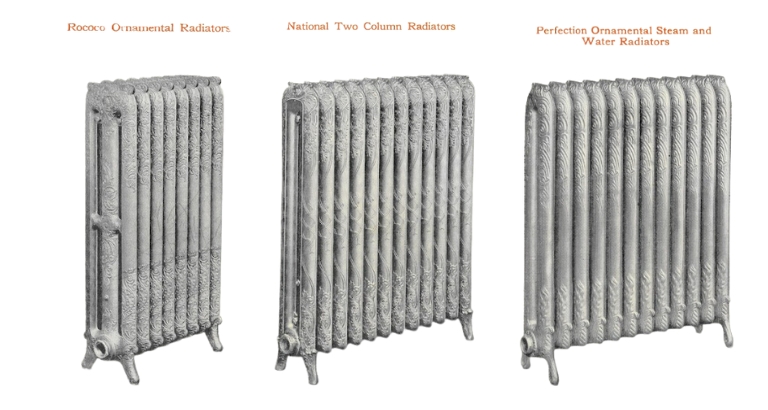
ARCo introduced a range of decorative radiators that quickly became popular. Models like the Rococo, National, and Perfection became particularly sought after, with many finding their way to the UK even before ARCo set up operations there in 1905.
Mastering Mass-Production
Before the age of mechanisation, radiator casts were created by workers who manually pressed patterns into a flask filled with fine sand. These patterns left imprints in the sand, which were then filled with molten iron to create the shape of the radiator.
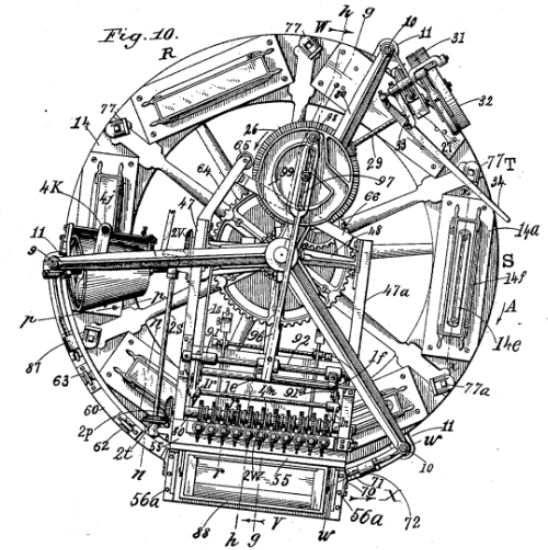
In 1895, the Bryant Iron Works in Niagara showcased a groundbreaking innovation: the Bryant Moulding Machine. Developed by Orrin Bryant for the Pierce Steam Heating Company before its merger into ARCo. A contemporary article praised it, noting, “It does the work of the human better than the human could possibly do it, and with a rapidity that is marvellous.”
This mechanised process allowed for the production of 2,500 casts every 10 hours, an astonishing leap from the 30 casts a skilled worker could produce in the same time. This advancement in mass production set a new standard in foundry technology and fuelled ARCo’s rapid expansion.
Image: An illustration of Orin Bryant’s patented moulding machine (1896).
Setting Sight For Europe
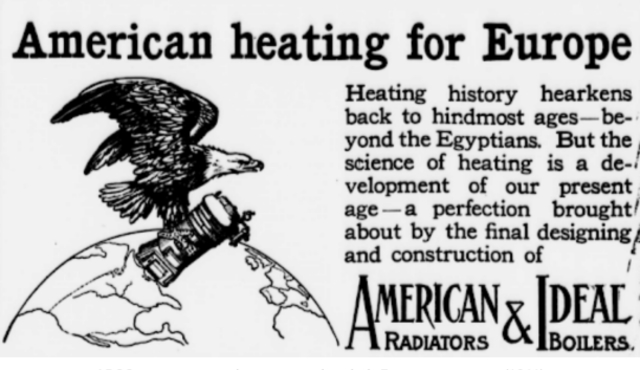
In 1897, after receiving numerous requests from heating contractors across Germany, France, Italy, Russia, and Spain, ARCo decided to establish a European presence. This led to the opening of a branch in Hamburg as well as a showroom in London on Queen Victoria Street.
By 1907, ARCo opened a manufacturing facility in Hull, England, making it the largest mechanised grey iron foundry in England, trading as the National Radiator Company. Two years later, ARCo’s European subsidiaries were so successful that they began generating more profit than the American parent company.
Image: ARCos newspaper advert promoting their European venture (1911)
Built to Last: The Legacy and Downfall of American Radiators
The same durability that made ARCo radiators a staple in homes and public buildings also contributed to the company’s eventual decline. Their radiators were built to last, which stood in stark contrast to the trend of planned obsolescence that became popular in later years. As a result, sales gradually slowed, and ARCo shifted focus, eventually becoming American Standard and expanding into the porcelain business.

Identifying an ARCo Radiator
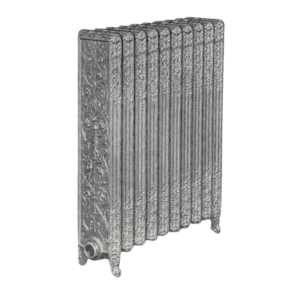
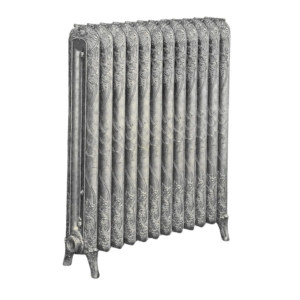
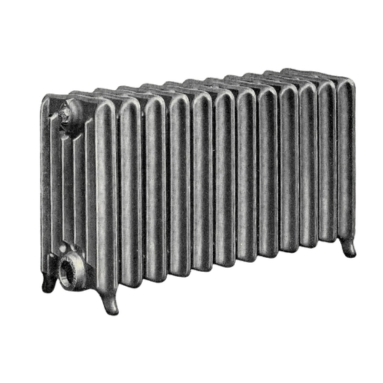
The American Radiator Company (ARCo) produced more cast iron radiator models than any other manufacturer, which can make identification tricky without recognising specific design motifs. Their early models were typically ornate, with many featuring intricate decorative patterns. If you come across an ornate radiator, it’s often an ARCo model or one produced by their British branch, the National Radiator Company.
A helpful clue for identifying early ARCo radiators is their bush ends, which were often designed to match the ornate detailing of the radiator itself. While this isn’t a guaranteed identifier, since ARCo bush ends could be fitted to other manufacturers’ radiators, it serves as a useful indicator.
Pictured left are some of their most popular bush ends over the years.
Image: A selection of ARCos most popular bush ends.
