




Crane
“Crane radiators and boilers are accepted as at least equal in design and workmanship to any others obtainable” Crane Radiators, Boilers and Radiator Accessories (1936)
The History of the Crane Company
Who Was the Crane Company?
Crane has been a key player in the heating and plumbing industries since the beginning, and their legacy continues today with the production of new cast iron radiators. Interestingly, early Crane radiators from the late 19th century were made from wrought iron tubing before transitioning to the cast iron designs they are known for today. Their most iconic model, the ‘Pall Mall’, remains the foundation for their modern cast iron column radiators.
What sets Crane apart is their wide-ranging influence. While their radiator business was second only to the American Radiator Company, they also became the world’s leading seller of valves and plumbing materials throughout the 20th century. Crane’s success across multiple industries demonstrates their exceptional ability to deliver quality, and their radiators stand as a testament to that expertise.
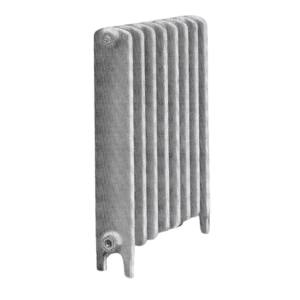
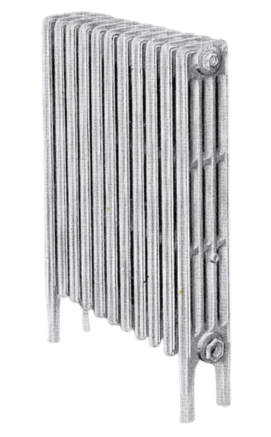
Image: The Crane ‘Pall Mall’ 4 column radiator featured in their 1936 catalogue.
Forged in Fire
The Crane Company was founded by Richard Teller Crane in 1855, then trading as R.T. Crane Brass and Bell Foundry, a man whose work ethic was shaped from an early age. At just 9 years old, he began working in a cotton mill, followed by stints in brass foundries, bell foundries, locomotive factories, and printing press shops all by the time he was 21. Initially focused on producing plumbing supplies and brass goods, the company grew steadily in its early years.
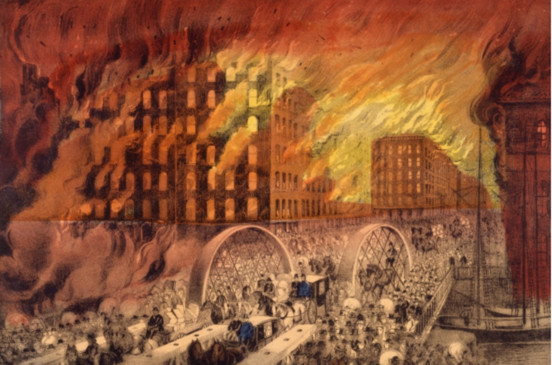
The turning point came after the Great Chicago Fire of 1871. About 17,500 buildings were destroyed in the fire, with over 100,000 people left homeless. As Chicago rebuilt from the ashes, the rebuilding efforts brought a surge in demand for plumbing and industrial supplies. With the city’s population booming and its skyline soaring, Crane’s expertise in piping and durable valves was crucial for the construction of taller buildings. This pivotal moment set the stage for the company’s rapid expansion and dominance in the manufacturing industry.
Image: Painting of the Great Chicago Fire across Randolph Street Bridge.
A Jack of All Trades
While Crane were originally known for their plumbing fixtures, their versatility soon extended far beyond. Radiators and boilers became an integral part of their business, but they didn’t stop there. In fact, modestly, Crane once claimed, “Crane radiators and boilers are accepted as at least equal in design and workmanship to any others obtainable.” They weren’t about being the loudest voice in the room, they simply delivered quality across the board.
By the mid-20th century, Crane’s influence had reached iconic milestones. In 1937, the company supplied the materials for the railings of the Golden Gate Bridge. Following the Second World War, their expertise turned to aviation, and, by 1969, their technology was used in both the Gemini and Apollo space missions.
Image: A painting of the Golden Gate Bridge in San Francisco.

Crane’s Move Into Radiator Manufacturing in Britain
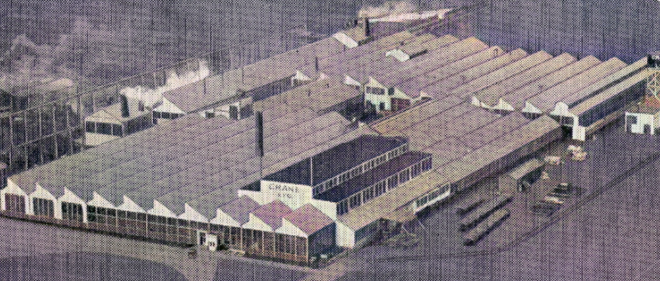
While Crane had established itself as a major player in the U.S. radiator market, it wasn’t until the early 20th century that they expanded into Europe. Following in the footsteps of companies like the American Radiator Company, Crane entered the British market in 1926, setting up a factory in Ipswich, Suffolk.
Crane’s decision to establish its British factory in Ipswich, Suffolk, may have been more than just strategic. The Crane family has ancestral roots in Ipswich, Massachusetts, which dates back to the early 17th century when members of the family emigrated from England to America. This connection between the two Ipswiches likely played a role in the choice of location, linking Crane’s British operations to its deeper heritage. By the 1970s, Crane’s Ipswich site had become the largest manufacturing employer in the area.
Image: Crane’s Ipswich factory, UK, from their catalogue (1936)
Identifying a Crane Radiator
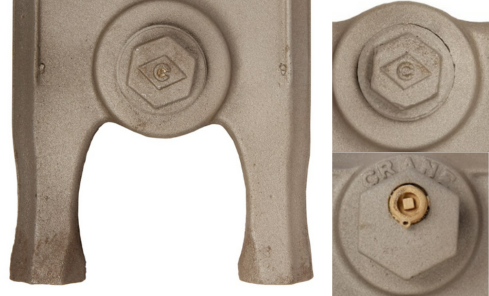
Identifying a Crane radiator can often be done through a few distinct features. The most straightforward method is to check for markings on the radiator itself, typically located above the radiator bush. In many cases, you’ll find the word ‘Crane’ clearly stamped on the top, as shown in the bottom right picture.
If the marking isn’t visible, you can also examine the legs. Crane radiators are known for their unique leg design, which features a slight inward bow at the middle. This subtle curve distinguishes them from other manufacturers like the National Radiator Company, whose radiators typically have fully flared legs with no bowing.
Lastly, check the bush end for another sign: a diamond with a ‘C’ inside it. However, be aware that this isn’t always definitive, Crane bush ends could have been added to non-Crane radiators at a later date.
Image: Crane’s most popular bush ends.